1984 McDonald’s Massacre Lawsuit: Foreseeability and Premises Liability Analysis
The 1984 McDonald’s massacre lawsuit (Lopez v. McDonald’s Corp.) remains the definitive legal benchmark for determining corporate liability in the face of mass violence. On July 18, 1984, James Oliver Huberty entered a McDonald’s restaurant in San Ysidro, California, and engaged in a 77-minute shooting rampage that left 21 people dead and 19 others wounded. While the tragedy was a criminal atrocity, the subsequent civil litigation focused on a specific point of law: whether the McDonald’s Corporation was negligent in failing to provide adequate security for its patrons.
The Negligence Claim: Foreseeability in High-Crime Areas
The plaintiffs—survivors and the families of the deceased—filed a lawsuit alleging premises liability and negligence. Their primary argument was built on the fact that the San Ysidro restaurant was located in an area with a significantly high crime rate. Evidence presented during the trial showed that the local violent crime rate was 228% higher than the city-wide average. Furthermore, plaintiffs revealed that a security firm had offered to provide uniformed guards for just $5.75 per hour, an offer the restaurant management reportedly declined, stating there was “no problem” at the location.
This rejection of security services became the focal point of the negligence claim. The plaintiffs argued that because McDonald’s knew the area was dangerous, it was “foreseeable” that a violent incident could occur. This legal theory is frequently invoked in modern consumer safety disputes, such as the Nissan door defect lawsuit, where the core of the argument is that a corporation’s knowledge of a specific risk (whether a mechanical failure or a security gap) creates a mandatory duty to act.
The Court’s Decision: The “Unprecedented” Standard
In 1987, the California Court of Appeal upheld a summary judgment in favor of McDonald’s. The court’s ruling hinged on the legal distinction between general crime and a “mass murderous assault.” While the court acknowledged that McDonald’s had a general duty to protect against foreseeable criminal acts (such as robberies or assaults), it ruled that a random, suicidal mass shooting was so “unprecedented” and “remote” that it fell outside the boundaries of a business’s legal obligations.
The Duty of Care and Public Policy
Judge Work, writing for the court, noted that holding a business liable for a “once-in-a-lifetime” massacre would create an impossible burden. The court reasoned that no amount of reasonable security, such as a single guard, could have reliably stopped a gunman armed with semi-automatic weapons. This focus on the “causal nexus” between the security failure and the injury is a recurring theme in complex litigation, including current tech-sector challenges like the Google lawsuit 2025, where courts must determine if a specific corporate policy directly caused a broader market harm.
Separate Litigation: Lopez v. City of San Diego
The 1984 McDonald’s massacre lawsuit also extended to the City of San Diego. Plaintiffs sued the police department, alleging “negligent rescue” because officers waited over an hour to neutralize the shooter. However, the court dismissed this claim as well, reinforcing the “Public Duty Doctrine.” This doctrine states that police do not have a “special relationship” with specific individuals that creates a duty to protect them, unless a specific promise of safety was made. This standard remains a cornerstone of law enforcement immunity in 2026.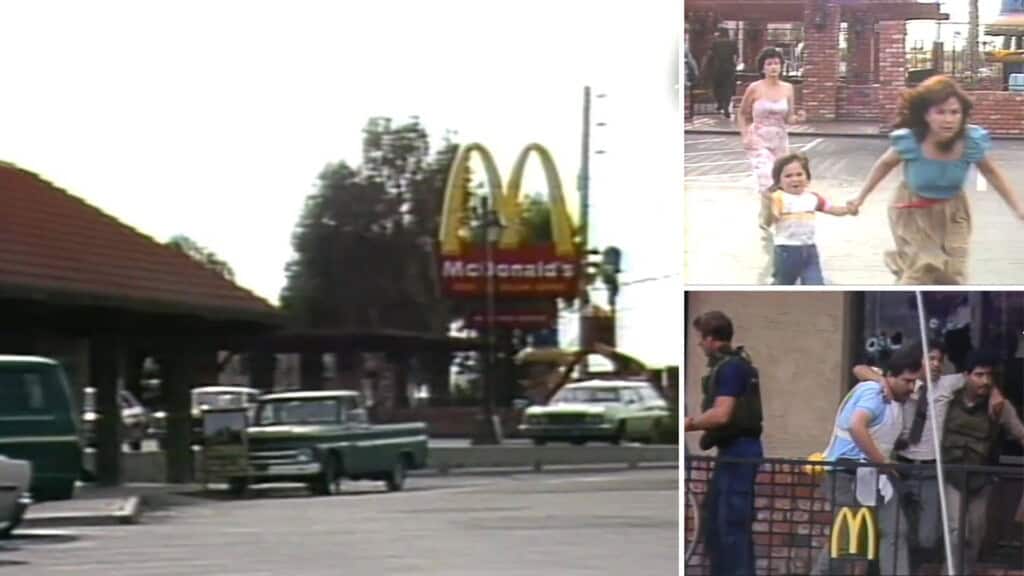
Legacy and Corporate Accountability
While McDonald’s was not legally found liable for the shooting, the company’s reaction changed how corporations handle mass tragedies. McDonald’s razed the building, donated the land for a memorial and a community college, and voluntarily established a fund to cover funeral and medical costs for the victims. This proactive approach to social responsibility is now a standard expectation for companies facing crises, from data breaches to product failures, as seen in the AT&T business billing lawsuit.
Key Legal Takeaways:
- Foreseeability: A business is only liable for crimes that are “reasonably predictable” based on past events.
- Public Duty: Law enforcement generally cannot be sued for the failure to provide a “timely rescue” during a mass shooting.
- Nexus of Causation: Plaintiffs must prove that specific security measures (like a guard) would have actually prevented the specific harm.
Conclusion
The 1984 McDonald’s massacre lawsuit continues to be taught in law schools as the definitive case on the limits of premises liability. It balances the rights of victims with the practical realities of business operations in a violent society. In 2026, as mass shootings unfortunately become more frequent, the “foreseeability” standard is being re-evaluated in jurisdictions across the country. Whether it is a university navigating a transfer portal ruling or a restaurant managing security, the principles established in the San Ysidro case remain vital for understanding institutional liability.