GM Engine Recall Lawsuit 2026: Navigating the Massive Consolidation and New Safety Probes
General Motors (GM) is currently facing one of the most significant legal and mechanical crises in its modern history. As of March 2026, the GM engine recall lawsuit has evolved from a series of individual complaints into a massive consolidated class action in the Eastern District of Michigan. This litigation, which combines over a dozen separate filings, centers on catastrophic internal defects within the 6.2L L87 and 5.3L V8 engines. For businesses and individuals relying on these vehicles within the integrated design and construction industry, the sudden loss of a fleet vehicle can lead to devastating project delays and safety hazards.
This article provides the latest March 2026 updates on the consolidated “Powell v. General Motors” case, the federal government’s deepening investigation into “failed recall remedies,” and what affected owners must do to protect their legal interests.
The 2026 Consolidation: One Massive Legal Front
In early 2026, U.S. District Judge Shalina D. Kumar ordered the formal consolidation of nearly a dozen lawsuits into a single, unified proceeding. This move was designed to streamline the discovery process and prevent conflicting rulings across different states. The consolidated complaint, filed on February 26, 2026, alleges that GM knowingly sold nearly 900,000 trucks and SUVs with “inherently defective” rotating assemblies and valvetrains.
Why Consolidation Matters for Plaintiffs
By merging these cases, the court has allowed plaintiffs to pool their resources, utilizing expert testimony from top automotive engineers to prove that the defects are systemic rather than isolated incidents. This procedural strategy is often seen in high-stakes litigation, much like the Schedule One lawsuit model, where the strength of the collective outweighs individual claims. For GM owners, this means a more efficient path toward a potential multi-billion dollar settlement or jury award.
NHTSA’s 2026 Probe into “Failed Remedies”
One of the most concerning developments in the GM engine lawsuit is the National Highway Traffic Safety Administration’s (NHTSA) decision to open a “Recall Query” in January 2026. This probe was triggered by reports that vehicles already “fixed” under the April 2025 recall were still experiencing total engine seizures. The original recall (25V-274) suggested that changing oil viscosity from 0W-20 to 0W-40 would protect at-risk bearings, but federal regulators now suspect this was merely a “Band-Aid” solution.
Failure of the 0W-40 Oil Change
- Continuing Seizures: NHTSA has received dozens of “Vehicle Owner Questionnaires” reporting failures on post-recall engines with less than 5,000 miles.
- Fuel Economy Penalties: Plaintiffs argue that the thicker oil reduces fuel efficiency, effectively forcing owners to pay more at the pump for an engine that is still a “ticking time bomb.”
- Resale Value: The public knowledge of these ongoing failures has led to a significant drop in trade-in values for affected Silverado and Sierra models.
The Lifter vs. Crankshaft Debate
The 2026 litigation highlights two distinct but related manufacturing flaws. While the GM 6.2L V8 L87 lawsuit focuses on “spun” rod bearings and crankshaft debris, a parallel legal battle focuses on the Active Fuel Management (AFM) and Dynamic Fuel Management (DFM) lifters. These lifters are prone to collapsing, which causes the engine to “shudder,” “tick,” and eventually stall.
In March 2026, a federal judge denied GM’s request to split these two issues into separate trials. This means the court will consider the entire “Engine System Defect” as a single failure of corporate quality control. This consolidation mirrors the complexity found in the GM 6.2L V8 L87 lawsuit, where both hardware and software integration are under the microscope.
New 2026 Lawsuits: The 1.2L Turbo Inline-3
While the V8 engines have dominated the headlines, March 2026 saw the filing of a new class action in Delaware (Cook v. General Motors). This suit alleges that the 1.2-liter turbo engines found in the 2024–2026 Chevrolet Trax and Buick Envista suffer from similar “connecting rod ejections.” This suggests that GM’s quality control issues may extend beyond their flagship trucks and into their compact SUV lineup. This expansion into different engine classes creates a legal environment similar to the Affirm class action lawsuit 2025, where multiple product lines were found to share a core systemic flaw.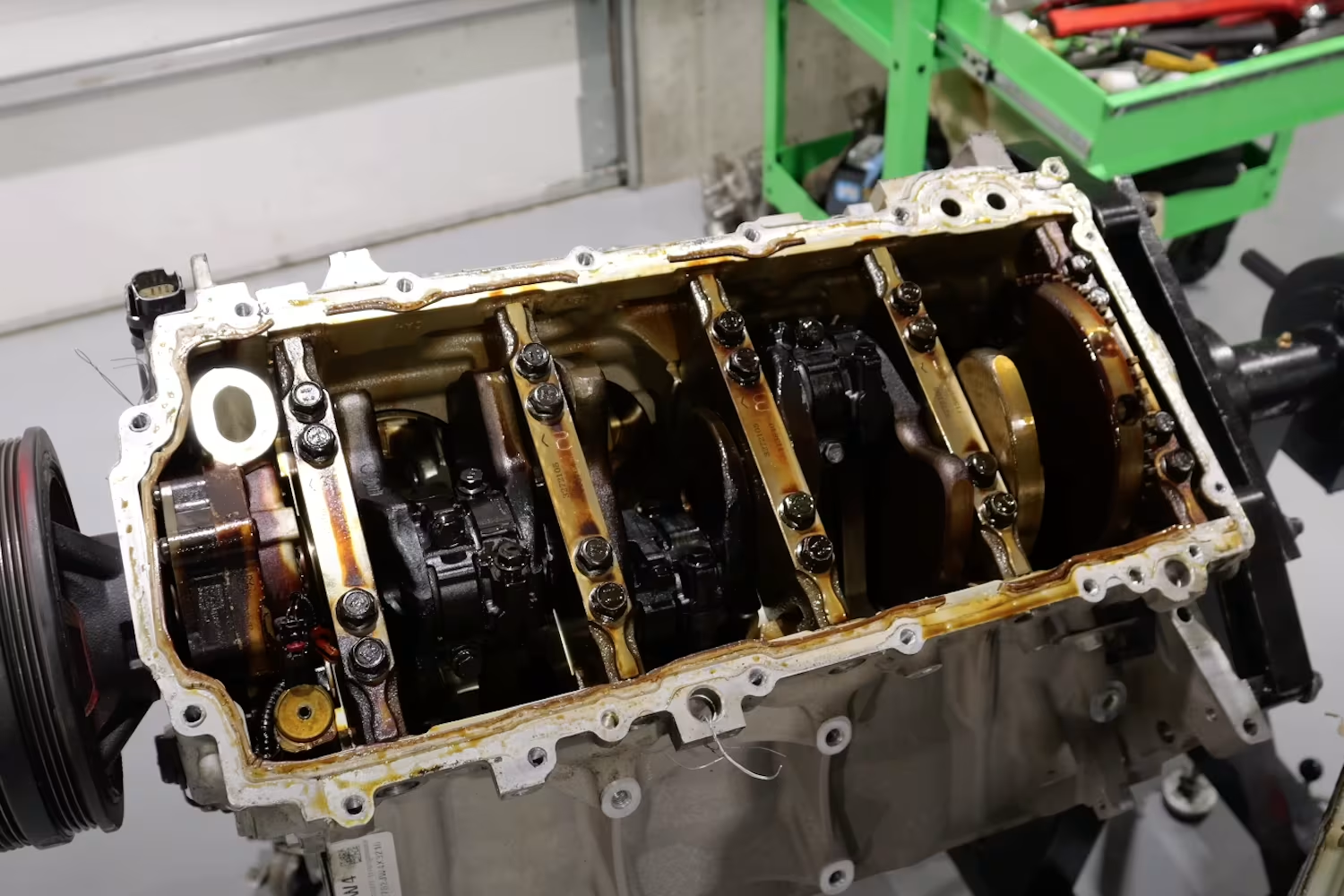
The “Total Engine Failure” Risk: A Safety Crisis
NHTSA and plaintiffs’ attorneys have categorized these engine defects as a “life-threatening” safety risk. A sudden engine seizure at highway speeds results in an immediate loss of power steering and braking assistance. As of early 2026, over 40 vehicle fires have been linked to connecting rods breaching the engine block and leaking hot oil onto the exhaust manifold. This is no longer just a financial dispute; it is a critical safety investigation that could lead to one of the largest mandatory buyback programs in automotive history.
Conclusion: What Affected Owners Should Do
If you own a 2019–2024 GM vehicle with a 6.2L or 5.3L engine, the GM engine recall lawsuit 2026 updates are vital to your safety and financial health. First, verify your VIN on the NHTSA website to see if your vehicle is part of the 25V-274 recall. Second, keep all service records, especially those showing “metal shavings in oil” or “knocking sounds.” Finally, consult with a lemon law or class action attorney before accepting any “goodwill” offers from GM that might require you to waive your right to join the consolidated class action. As the March 30, 2026, deadline for GM to file its formal defense approaches, the window for owners to document their claims is narrowing.