Nissan VC-Turbo Engines Lawsuit: 2026 Recall Expansion and 10-Year Warranty Extension
The innovative but troubled variable-compression technology from Nissan is facing its most significant legal and mechanical challenge to date. As of March 17, 2026, the Nissan VC-Turbo engines lawsuit (Becker et al. v. Nissan North America, Inc.) has gained new momentum following back-to-back massive recalls in early 2026. While Nissan spent two decades developing the VC-Turbo to bridge the gap between performance and efficiency, a series of catastrophic engine failures—ranging from seized bearings to breached engine blocks—has led to a consolidated class action lawsuit and federal investigations affecting over 750,000 vehicles across the Nissan and Infiniti lineups.
The 2026 Recall Expansion: 323,000 More Rogues
On February 12, 2026, Nissan North America issued an urgent expansion of its previous engine safety recalls. The new action (NHTSA Campaign 26V080) targets 323,917 Nissan Rogue SUVs from the 2023–2025 model years equipped with the 1.5-liter three-cylinder VC-Turbo engine. According to federal reports, high operating temperatures can cause engine oil to break down prematurely, leading to catastrophic bearing seizure. This can result in a total loss of motive power or, in rare cases, a breached engine block that leaks hot oil onto the exhaust, creating a severe fire risk.
This “design-level” failure is the focal point of the ongoing litigation. Much like the GM 5.3L V8 engine lawsuit, plaintiffs argue that the manufacturer prioritized marketing claims of “innovation” over basic mechanical reliability. In Nissan’s case, the complexity of the variable compression linkages is alleged to be a fundamental weak point that cannot be fixed with a simple software update.
The 10-Year / 120,000-Mile Warranty Extension
In a move to stave off further litigation and appease federal regulators, Nissan announced in March 2026 that it is extending the powertrain warranty for all affected VC-Turbo vehicles to 10 years or 120,000 miles. This extension applies to owners who bring their vehicles in for the required recall inspections. The current remedy involves:
- Software Reprogramming: Updating the Engine Control Module (ECM) to better manage oil temperatures.
- Oil Pan Inspection: Dealers must check for metal shavings or “shimmer” in the oil, which indicates bearing degradation.
- Full Engine Replacement: If debris is found, Nissan has committed to replacing the entire engine assembly at no cost.
However, the Nissan VC-Turbo engines lawsuit plaintiffs argue this remedy is “woefully inadequate.” They claim that replacing a defective engine with another engine of the same design only resets the clock on a future failure. This “inadequate remedy” argument is also seen in the Gmail lawsuit claim form 2025 updates, where consumers argue that small payouts do not address the systemic lack of transparency from the corporation.
“Dark Patterns” in Engine Software?
A secondary recall issued in February 2026 involves the electronic throttle body on 318,781 Rogues (2024–2025). Internal gears made of polymer were found to fracture during a routine startup diagnostic test. While Nissan is fixing this with a software patch, the lawsuit alleges that Nissan’s reliance on software to mask physical hardware deficiencies constitutes a “deceptive trade practice.” This mirrors the Roblox lawsuit addiction claims, where software “loops” are scrutinized for creating outcomes (mechanical or psychological) that the user cannot control.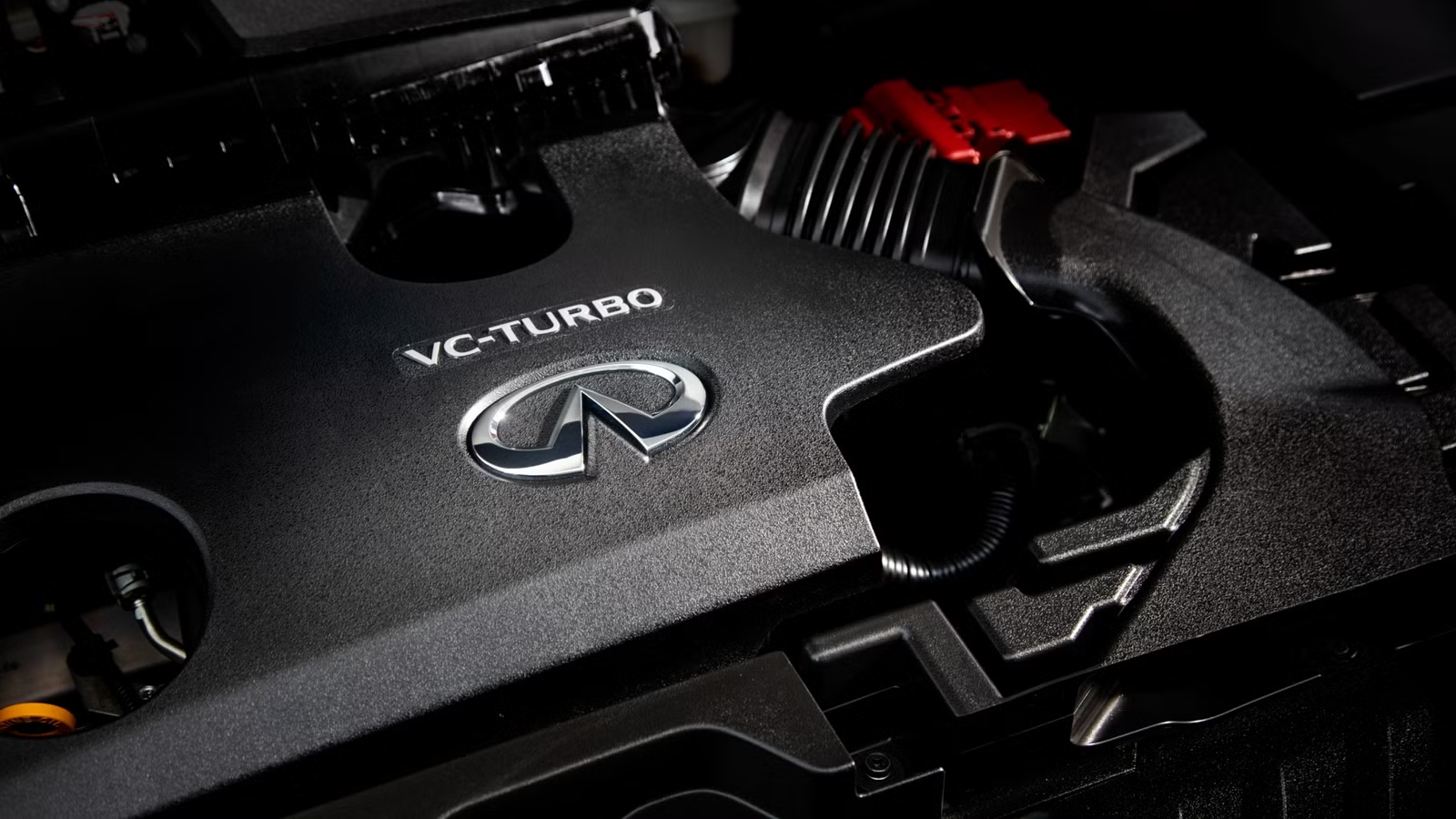
Vehicles Named in the 2026 Litigation & Recalls:
| Make/Model | Model Years | Engine Type |
|---|---|---|
| Nissan Rogue | 2021–2025 | 1.5L 3-Cylinder VC-Turbo |
| Nissan Altima | 2019–2023 | 2.0L 4-Cylinder VC-Turbo |
| Infiniti QX50 / QX55 | 2019–2023 | 2.0L 4-Cylinder VC-Turbo |
What Owners Should Do in 2026
Owners of these models are encouraged to monitor their dashboard for “Engine Malfunction” or “Power Reduced” warnings. If you have already paid for an out-of-pocket engine replacement, the Nissan VC-Turbo engines lawsuit seeks to secure full reimbursement plus additional damages for loss of vehicle value. This path toward restitution is similar to the FBI mistaken raid Atlanta lawsuit, where the focus has shifted from an initial apology to a court-ordered financial recovery for the victims’ losses.
Conclusion: The Cost of Complexity
In conclusion, the Nissan VC-Turbo engines lawsuit highlights the risks of introducing highly complex mechanical systems into mass-market vehicles. With over 640,000 Rogues alone facing engine and throttle risks in early 2026, Nissan’s “variable compression” experiment is currently undergoing its ultimate trial in the courtroom. Whether the 10-year warranty will be enough to settle the class action remains to be seen, but for now, owners should prioritize the free inspections to ensure their “innovative” engine doesn’t become a safety hazard.